Babylon 5 - The Lost Tales: Voices in the Dark
review by John W. Herbert
Babylon 5 is back in the first of what is hoped to be a series made-for-DVD adventures under the moniker The Lost Tales. The first disc, entitled Voices in the Dark, contains two short tales both written and directed by Babylon 5 creator J. Michael Straczynski.
Set ten years after the original series, the first story involves B5 commander Colonel Lochley (Tracy Scoggins) who has summoned a priest to B5. She is convinced that a crewman on the station has been possessed by a demon and only an exorcism can save the unfortunate victim presumably destroy the demon. However, the demon insists on being exorcised, and this presents the priest with an ethical dilemma.
In story two, President Sheridan (Bruce Boxleitner) is on his way to B5 for a ceremonial function when Galen the technomage (Peter Woodward) visits him and presents him with his own ethical dilemma: a teen-aged Centauri Prince that is traveling on the same ship as Sheridan will grow up to lead a devastating Centauri attack on Earth. Galen wants Sheridan to kill the teenager before he grows up to be the Centauri's leader and bring havoc and chaos to the galaxy. Essentially the question Sheridan faces is the Babylon 5 version of would you go back in time and kill Hitler as a boy?
These are short tales, each clocking in at only about 35 minutes. Straczynski has said he wished to approach this new project as an anthology show, telling small stories in the corners of the B5 universe. Perhaps he has succeeded too well in this. The stories, especially the first one, are very talky. There's only six speaking parts across both stories, and barely an extra in sight. But where they lack in action, they make up for in philosophical meanderings.
The stories are also perhaps too similar. In both cases, Lochley and Sheridan solve their puzzles by playing back something that was previously said, Lochley by listening to a tape playback while staring out alone into space, and Sheridan by running back a conversation in his mind while flying alone in a spacecraft. (Maybe that's way this set is called Voices in the Dark.) This isn't to say that the stories are not entertaining -- they are -- but there seems little to tie them to the overarching Babylon 5 canvas, and that's a pity. Mind you, enough plot threads are left dangling from the Sheridan sequence that it could be easily picked up in further installments.
The special effects are very good and Straczynski's direction is good, too. He effectively uses some interesting camera work in the Lochley segment, and he keeps a sure hand on the proceedings. The actors seem to be pleased to be reprising their roles, particularly Boxleitner and Woodward who seem to having immense fun in their scenes together.
The DVD contains many behind the scenes features, in total as long as the feature itself. What is sorely missing is a commentary track, but on the other hand the reenactment of a major scene from the show using sock puppets almost makes up for that gaffe.
So while it is not as effective as it could have been, this first volume of The Lost Tales marks a successful return of Babylon 5 to our screens, and here's hoping that there is a second helping soon.
Showing posts with label tv. Show all posts
Showing posts with label tv. Show all posts


Ark II - The Complete Series
review by John W. Herbert
On the scorched and polluted Earth of the 25th century, three young scientists and their hyper-intelligent talking chimpanzee roam the land in Ark II, a sophisticated mobile lab and research centre, to help rebuild and restore civilization. Led by Jonah (played by the late Terry Lester), every week he and his crew -- Ruth (Jean Marie Hon), Samuel (Jose Flores) and Adam (Moochie the chimp) – would help villagers and farmers fend off environmental scourges, scavengers, crazy computers or immortal demagogues in a non-violent manner.
It was Saturday mornings, after all.
In fact Ark II was the most expensive live-action Saturday morning kids’ show of its time. Produced by Filmation, it premiered in September 1976, and although only 15 episodes were produced, remained on the air until 1979. It featured some great guest stars – Jonathan Harris, Malachi Throne, Del Munroe, a very young Helen Hunt, Jim Backus and Robbie the Robot (uncredited, alas) – as well as some very cool vehicles.
The premise of each episode was often similar: the Ark crew would be assigned (by a never-seen headquarters) to investigate some strange happening in a village. The villagers would be often fearful of the Ark and its crew, Ruth or Samuel would get into trouble, but then the villagers would realize the error of their ways and everything would turn out okay. But not before Jonah would have to fly around in his jet-pack. (And no wires here, kids – it was a real flying jetpack. Is that cool or what?))
It wasn’t as cheesy as it sounds, although the production values are sometimes lacking (each episode was shot in only three days). Each episode contained a “message,” but viewers were never slammed over the head with it and the show never sank to the level of cliché. They even went out of their way to avoid the obvious cliché – Adam the chimp is never played for comedy relief; he was an equal member of the crew. Even if he was wearing a diaper under his costume.
The show was shot on 16mm film, so it’s never going to look great. That said, the newly remastered DVD release makes the series look pretty good. And for a 30 year-old series that only filmed 15 episodes, there’s a wealth of behind-the-scenes material: two episode commentaries, a new “making of” documentary, plus assorted photo and art galleries. But wait – there’s more! Also included is DVD-Rom material, including all the shooting scripts, plus the series bible.
Many of the Filmation live-action Saturday morning shows are due to be released on DVD in 2007.
Can a review of Jason of Star Command be far behind?
On the scorched and polluted Earth of the 25th century, three young scientists and their hyper-intelligent talking chimpanzee roam the land in Ark II, a sophisticated mobile lab and research centre, to help rebuild and restore civilization. Led by Jonah (played by the late Terry Lester), every week he and his crew -- Ruth (Jean Marie Hon), Samuel (Jose Flores) and Adam (Moochie the chimp) – would help villagers and farmers fend off environmental scourges, scavengers, crazy computers or immortal demagogues in a non-violent manner.
It was Saturday mornings, after all.
In fact Ark II was the most expensive live-action Saturday morning kids’ show of its time. Produced by Filmation, it premiered in September 1976, and although only 15 episodes were produced, remained on the air until 1979. It featured some great guest stars – Jonathan Harris, Malachi Throne, Del Munroe, a very young Helen Hunt, Jim Backus and Robbie the Robot (uncredited, alas) – as well as some very cool vehicles.
The premise of each episode was often similar: the Ark crew would be assigned (by a never-seen headquarters) to investigate some strange happening in a village. The villagers would be often fearful of the Ark and its crew, Ruth or Samuel would get into trouble, but then the villagers would realize the error of their ways and everything would turn out okay. But not before Jonah would have to fly around in his jet-pack. (And no wires here, kids – it was a real flying jetpack. Is that cool or what?))
It wasn’t as cheesy as it sounds, although the production values are sometimes lacking (each episode was shot in only three days). Each episode contained a “message,” but viewers were never slammed over the head with it and the show never sank to the level of cliché. They even went out of their way to avoid the obvious cliché – Adam the chimp is never played for comedy relief; he was an equal member of the crew. Even if he was wearing a diaper under his costume.
The show was shot on 16mm film, so it’s never going to look great. That said, the newly remastered DVD release makes the series look pretty good. And for a 30 year-old series that only filmed 15 episodes, there’s a wealth of behind-the-scenes material: two episode commentaries, a new “making of” documentary, plus assorted photo and art galleries. But wait – there’s more! Also included is DVD-Rom material, including all the shooting scripts, plus the series bible.
Many of the Filmation live-action Saturday morning shows are due to be released on DVD in 2007.
Can a review of Jason of Star Command be far behind?
Lost - Season One
review by John W. Herbert
Imagine being marooned on a desert island in a plane crash with forty-plus other people. The plane was off-course, no one knows where you are. You’re running out of food, water, supplies. Things look grim. Slowly you discover that some of the people on the island with you are not what they appear to be. Even worse, the same is true of the island. You are well and truly Lost.
Season One of Lost, now out on DVD, sets up what may be the beginning of a long-running tv show (or maybe not — more on that later). As our castaways try to survive, they learn that some sort of unseen monster prowls the island, and that others are on the island.
The show is basically a gimmick show, with two great gimmicks. The first gimmick is the dramatic structure of the show which is a terrific idea. While we follow the adventures of our stranded castaways, we also relive moments of their lives in flashbacks. Why were each of these people of that particular flight? The flashbacks are a great way of filling in the backstory of the characters. We, as the audience, learn so much about these characters, way more in fact than the rest of the islanders do, and we understand a character’s motivation for doing something, even when their comrades do not. A brilliant conceit and it makes for riveting television.
Number two, the island itself holds many secrets and mysteries. What about the hatch? What’s with the polar bears? Who are the others? What’s up with the invisible monster? Is the kid psychic or telekinetic? And this is the gimmick which may be the show’s downfall.
A show relying on a mystery or a gimmick to survive may collapse under the weight of its own backstory (witness The X-Files). If you’re not playing fair with your audience and revealing some of the mystery of the island, your audience will leave you, um, deserted.
This season’s Lost ratings are suffering. Could it be that the gimmick has worn off already? Only time will tell.
Imagine being marooned on a desert island in a plane crash with forty-plus other people. The plane was off-course, no one knows where you are. You’re running out of food, water, supplies. Things look grim. Slowly you discover that some of the people on the island with you are not what they appear to be. Even worse, the same is true of the island. You are well and truly Lost.
Season One of Lost, now out on DVD, sets up what may be the beginning of a long-running tv show (or maybe not — more on that later). As our castaways try to survive, they learn that some sort of unseen monster prowls the island, and that others are on the island.
The show is basically a gimmick show, with two great gimmicks. The first gimmick is the dramatic structure of the show which is a terrific idea. While we follow the adventures of our stranded castaways, we also relive moments of their lives in flashbacks. Why were each of these people of that particular flight? The flashbacks are a great way of filling in the backstory of the characters. We, as the audience, learn so much about these characters, way more in fact than the rest of the islanders do, and we understand a character’s motivation for doing something, even when their comrades do not. A brilliant conceit and it makes for riveting television.
Number two, the island itself holds many secrets and mysteries. What about the hatch? What’s with the polar bears? Who are the others? What’s up with the invisible monster? Is the kid psychic or telekinetic? And this is the gimmick which may be the show’s downfall.
A show relying on a mystery or a gimmick to survive may collapse under the weight of its own backstory (witness The X-Files). If you’re not playing fair with your audience and revealing some of the mystery of the island, your audience will leave you, um, deserted.
This season’s Lost ratings are suffering. Could it be that the gimmick has worn off already? Only time will tell.
The Adventures of Brisco County, Jr.
review by John W. Herbert
In the fall of 1993, a new show premiered on Friday nights on Fox. It followed two partners who brought in the bad guys, while encountering strange paranormal events and a government conspiracy to cover them up. It debuted to good ratings and great reviews. And it had a horse who thought he was a human. No, we aren't talking about the X-Files. We're talking about that other show, a comedy/western/sf hybrid that was broadcast an hour before Scully and Mulder: The Adventures of Brisco County, Jr.
The set-up was a classic western motif: in 1893, bad guy John Bly breaks out of custody with his gang, killing Marshall Brisco County, Sr. Bounty hunter Brisco Jr. is hired by rail barons to hunt down Bly and his gang, but because of the high price on Bly's head, Brisco is in competition with other bounty hunters, including the notorious Lord Bowler. But Bly has bigger fish to fry, and here's where the show becomes more than just a western. Bly's after a mysterious golden orb that has strange mystical powers.
Sent on missions by his boss Socrates Poole, Brisco encounters more than his share of outrageous characters along the trail: noted gunslinger Utah Johnny Montana (who used to be called Utah Johnny Cougar Montana but stopped using Cougar as it sounded too pretentious); the hapless bad guy Pete who dies more times than South Park's Kenny and has an unhealthy attachment to his pistol ("You're touching my piece! Nobody touches Pete's Piece!"); Sheriff Aron Viva (an ancestor of Elvis's); and Professor Wickwire, who invents, among other things, a rocket car, a diving suit and an airship (apparently financed by a German investor named Von Zeppelin). Brisco also has more than a few encounters with a saloon siren, the delectable Dixie Cousins.
The superb cast is anchored by B-movie hero Bruce Campbell as Brisco. He brings just the right amount of sincerity, strength and good humour to the role. No one will ever accuse him of being a great actor, but Campbell is perfect for this role. It's hard to imagine anyone else in the part. Julius Carry brought his very large presence to the character of Lord Bowler, a fellow bounty hunter who eventually teams up with Brisco. And the legendary John Astin brought his quirky charms to Professor Wickwire. Plus, special mention must be made of Billy Drago, who played Brisco's nemesis John Bly like he was from another planet (there's a hint for you).
It's not hard to see why Brisco's rating floundered as the season went on and was eventually canceled after after only one season; it's a very offbeat show, with wacky humour strewn among the pop-cult references. It's a western poking fun at western conventions. And it's also a sci-fi show, with the mysterious orb and its fantastic power the driving force behind many episodes. It's no wonder viewers didn't know what to make of it, but I enjoyed it a lot. I was surprised that the orb storyline was wrapped up about three-quarters of the way through the season, but I suspect had Brisco returned for a second season that the orb and John Bly would have returned. It was the orb plot that made the show something unique and after that was seemingly dealt with, the show settled back into being just a western, albeit a light and occasionally silly one. And although Brisco was criticized for being an overly violent show back in the day, Brisco never actually shot anyone.
The DVD box set has the complete series, plus a commentary track featuring Bruce Campbell and series co-creator Carlton Cuse on the pilot episode. They paint a fun picture, describing a hard but enjoyable shoot, and they also reveal all (such as it is) about the orb. There's also a short "making of" documentary, and a brief bit with Bruce Campbell reading from his book If Chins Could Kill. The highlight of the special features is a 45-minute round table discussion with the writers and co-creator Cuse. (A few of the writers now work on Lost, and viewers of that show might want to pay particular attention when the discussion turns to "orb mythology.")
So spend a few bucks and harken back to the thrilling days of yesteryear....
originally published in UTOH #18, October 2006
In the fall of 1993, a new show premiered on Friday nights on Fox. It followed two partners who brought in the bad guys, while encountering strange paranormal events and a government conspiracy to cover them up. It debuted to good ratings and great reviews. And it had a horse who thought he was a human. No, we aren't talking about the X-Files. We're talking about that other show, a comedy/western/sf hybrid that was broadcast an hour before Scully and Mulder: The Adventures of Brisco County, Jr.
The set-up was a classic western motif: in 1893, bad guy John Bly breaks out of custody with his gang, killing Marshall Brisco County, Sr. Bounty hunter Brisco Jr. is hired by rail barons to hunt down Bly and his gang, but because of the high price on Bly's head, Brisco is in competition with other bounty hunters, including the notorious Lord Bowler. But Bly has bigger fish to fry, and here's where the show becomes more than just a western. Bly's after a mysterious golden orb that has strange mystical powers.
Sent on missions by his boss Socrates Poole, Brisco encounters more than his share of outrageous characters along the trail: noted gunslinger Utah Johnny Montana (who used to be called Utah Johnny Cougar Montana but stopped using Cougar as it sounded too pretentious); the hapless bad guy Pete who dies more times than South Park's Kenny and has an unhealthy attachment to his pistol ("You're touching my piece! Nobody touches Pete's Piece!"); Sheriff Aron Viva (an ancestor of Elvis's); and Professor Wickwire, who invents, among other things, a rocket car, a diving suit and an airship (apparently financed by a German investor named Von Zeppelin). Brisco also has more than a few encounters with a saloon siren, the delectable Dixie Cousins.
The superb cast is anchored by B-movie hero Bruce Campbell as Brisco. He brings just the right amount of sincerity, strength and good humour to the role. No one will ever accuse him of being a great actor, but Campbell is perfect for this role. It's hard to imagine anyone else in the part. Julius Carry brought his very large presence to the character of Lord Bowler, a fellow bounty hunter who eventually teams up with Brisco. And the legendary John Astin brought his quirky charms to Professor Wickwire. Plus, special mention must be made of Billy Drago, who played Brisco's nemesis John Bly like he was from another planet (there's a hint for you).
It's not hard to see why Brisco's rating floundered as the season went on and was eventually canceled after after only one season; it's a very offbeat show, with wacky humour strewn among the pop-cult references. It's a western poking fun at western conventions. And it's also a sci-fi show, with the mysterious orb and its fantastic power the driving force behind many episodes. It's no wonder viewers didn't know what to make of it, but I enjoyed it a lot. I was surprised that the orb storyline was wrapped up about three-quarters of the way through the season, but I suspect had Brisco returned for a second season that the orb and John Bly would have returned. It was the orb plot that made the show something unique and after that was seemingly dealt with, the show settled back into being just a western, albeit a light and occasionally silly one. And although Brisco was criticized for being an overly violent show back in the day, Brisco never actually shot anyone.
The DVD box set has the complete series, plus a commentary track featuring Bruce Campbell and series co-creator Carlton Cuse on the pilot episode. They paint a fun picture, describing a hard but enjoyable shoot, and they also reveal all (such as it is) about the orb. There's also a short "making of" documentary, and a brief bit with Bruce Campbell reading from his book If Chins Could Kill. The highlight of the special features is a 45-minute round table discussion with the writers and co-creator Cuse. (A few of the writers now work on Lost, and viewers of that show might want to pay particular attention when the discussion turns to "orb mythology.")
So spend a few bucks and harken back to the thrilling days of yesteryear....
originally published in UTOH #18, October 2006
The Lone Gunmen – The Complete Series
review by John W. Herbert
Freshly out on DVD is The Lone Gunmen, a short-lived spin-off that aired 13 episodes in early 2001, taking a trio of characters from the popular X-Files tv series.
The title characters are three conspiracy nut/hackers/journalists who publish a small press newspaper, The Lone Gunman: John Fitzgerald Byers (played by Bruce Harwood), Melvin Frohike (Tom Braidwood), and Richard Langly (Dean Haglund). Joining them in the series is their new intern, a painfully earnest but not too bright young football coach with the improbable name of James "Jimmy" Bond. They are also sometimes both aided and thwarted by a mysterious female operative by the even more improbable name of Yves Adele Harlow (an anagram of Lee Harvey Oswald).
While the X-Files explored conspiracies of science fictional or supernatural origin, The Lone Gunmen are concerned with more earthly conspiracies: has the automobile industry covered up the existence of a water powered car; is the latest computer chip also spying on its users; and the holy grail of conspiracies, who killed JFK.
The Lone Gunmen’s only real claim to television history might be the plot of the pilot episode, which aired in March of 2001, in which a rogue group of American government officials, trying to increase flat weapons sales, um, hijack a fully loaded passenger jet intending to crash it into the World Trade Center, and it will be blamed on the "dozen tin pot dictators all over the world clamouring to take responsibility and just begging to be smart-bombed," and lots of money will be made by American arms dealers. So the next time you here a politician say no one could have predicted the method of the 9/11 terrorist attacks, they obviously weren’t watching The Lone Gunmen.
In fact, not many people were watching The Lone Gunmen, and it easy to see why in some ways as early on some jokes were repeated ad naseum. Early episodes contained unfunny body function humour that went on too long, such as Langly puking and Frohike farting. Many episodes contain the same basic formula: a stranger approaches the Gunmen with a mystery that needs solving, but only after things go wrong do the Gunmen discover through some simple checking that it was the stranger that has been setting them up all the time. It also seems that the Fox network failed to get behind the show, and as the X-Files was nearing the end of its run, the network wanted to put the show, and any spin-offs, behind it.
But for the most part, The Lone Gunmen is entirely enjoyable. While most episodes strove to walk the fine line between being a comedy and a drama (and didn’t always succeed), there are a number of episodes that caught the balance just right. And a few that were downright suspenseful and thrilling. And when they stayed away from the bathroom humour, they did have a few genuinely funny running gags, particularly the one depicting Frohike as the ladies’ man of the bunch.
The cast is uniformly excellent, particularly the three leads. And kudos to Stephen Seddon, charged with the thankless task of playing the sometimes near-moronic Jimmy Bond. Seddon throws himself into playing Bond, and captures the romantic soul and dignity beneath Bond’s lack of intellect. And more kudos to Mitch Pileggi for his hilarious guest shot as FBI Assistant Director Walter Skinner (Scully and Mulder’s boss)
There are some bonus features, including four episode commentaries by the cast and crew, and a nice little documentary. The best feature, however, is the inclusion of the X-Files episode "Jump the Shark," which resolves the cliff-hanger ending of the final Lone Gunmen episode, and reveals the ultimate fate of our conspiracy-minded trio.
Reasonably-priced and more than reasonable entertainment, The Lone Gunmen is a conspiracy worth pursuing.
(originally published in Under the Ozone Hole #17)
Freshly out on DVD is The Lone Gunmen, a short-lived spin-off that aired 13 episodes in early 2001, taking a trio of characters from the popular X-Files tv series.
The title characters are three conspiracy nut/hackers/journalists who publish a small press newspaper, The Lone Gunman: John Fitzgerald Byers (played by Bruce Harwood), Melvin Frohike (Tom Braidwood), and Richard Langly (Dean Haglund). Joining them in the series is their new intern, a painfully earnest but not too bright young football coach with the improbable name of James "Jimmy" Bond. They are also sometimes both aided and thwarted by a mysterious female operative by the even more improbable name of Yves Adele Harlow (an anagram of Lee Harvey Oswald).
While the X-Files explored conspiracies of science fictional or supernatural origin, The Lone Gunmen are concerned with more earthly conspiracies: has the automobile industry covered up the existence of a water powered car; is the latest computer chip also spying on its users; and the holy grail of conspiracies, who killed JFK.
The Lone Gunmen’s only real claim to television history might be the plot of the pilot episode, which aired in March of 2001, in which a rogue group of American government officials, trying to increase flat weapons sales, um, hijack a fully loaded passenger jet intending to crash it into the World Trade Center, and it will be blamed on the "dozen tin pot dictators all over the world clamouring to take responsibility and just begging to be smart-bombed," and lots of money will be made by American arms dealers. So the next time you here a politician say no one could have predicted the method of the 9/11 terrorist attacks, they obviously weren’t watching The Lone Gunmen.
In fact, not many people were watching The Lone Gunmen, and it easy to see why in some ways as early on some jokes were repeated ad naseum. Early episodes contained unfunny body function humour that went on too long, such as Langly puking and Frohike farting. Many episodes contain the same basic formula: a stranger approaches the Gunmen with a mystery that needs solving, but only after things go wrong do the Gunmen discover through some simple checking that it was the stranger that has been setting them up all the time. It also seems that the Fox network failed to get behind the show, and as the X-Files was nearing the end of its run, the network wanted to put the show, and any spin-offs, behind it.
But for the most part, The Lone Gunmen is entirely enjoyable. While most episodes strove to walk the fine line between being a comedy and a drama (and didn’t always succeed), there are a number of episodes that caught the balance just right. And a few that were downright suspenseful and thrilling. And when they stayed away from the bathroom humour, they did have a few genuinely funny running gags, particularly the one depicting Frohike as the ladies’ man of the bunch.
The cast is uniformly excellent, particularly the three leads. And kudos to Stephen Seddon, charged with the thankless task of playing the sometimes near-moronic Jimmy Bond. Seddon throws himself into playing Bond, and captures the romantic soul and dignity beneath Bond’s lack of intellect. And more kudos to Mitch Pileggi for his hilarious guest shot as FBI Assistant Director Walter Skinner (Scully and Mulder’s boss)
There are some bonus features, including four episode commentaries by the cast and crew, and a nice little documentary. The best feature, however, is the inclusion of the X-Files episode "Jump the Shark," which resolves the cliff-hanger ending of the final Lone Gunmen episode, and reveals the ultimate fate of our conspiracy-minded trio.
Reasonably-priced and more than reasonable entertainment, The Lone Gunmen is a conspiracy worth pursuing.
(originally published in Under the Ozone Hole #17)
Star Trek: The Next Generation -- "Unification I" and "Unification II"
review by John W. Herbert
It sounded too good to be true: Leonard Nimoy guest starring as Spock in a two-part TNG episode wherein Spock attempts to reunite the Vulcans and the Romulans. But alas....
The first episode sets up the play: Ambassador Spock has mysteriously travelled to the Romulan homeworld, Romulus. Has he defected? Picard and the Enterprise are ordered to find out. After a brief visit to Spock's father, the dying Sarak, Picard and Data borrow a Klingon ship and crew in order to approach Romulus under the protection of the Klingon ship's cloaking field. Picard and Data, in the guise of Romulans, beam down in an attempt to meet Pardek, a Romulan politician whom they feel Spock may try to contact. They are correct; Pardek leads them to Spock. Meanwhile, Riker has his own mystery to solve: someone has stolen a Vulcan ship from a Starfleet junkyard.
All in all, the first part does a fairly good job of setting things up. Unfortunately, everyone takes a large dose of 'stupid pills' for the second part and it all falls apart.
It turns out that Pardek helping Spock with his unification plans has been part of a bigger plan by Commander Sela, the blonde Romulan with the uncanny resemblance to the late Tasha Yar, to use Spock in an unwitting attempt to take over Vulcan. By making the Federation believe that Spock's negotiations have been successful, she plans to use stolen Vulcan ships to carry an attack force to Vulcan. The attack force, a mere two thousand troops, will dig themselves in (and do what? That's never made clear.) Two thousand troops doesn't seem like to hold a key planet presumably deep in the heart of the Federation. (Apart from the fact that Starfleet weapons are accurate to within a city block and could stun all the enemy troops from orbit, Starfleet could blockade the planet and starve them out. Sure, it's bad news for Vulcan in the short term, but there's no military advantage for the Romulans to be gained here; they're just being bad guys for the sake of being bad guys. And why aren't any Romulan citizens suspicious about this Vulcan that's running around?)
Later, Picard, Data, and Spock are betrayed by Pardek and brought to Sela, who, after spilling the beans about her plan, leaves the three of them, three of the most resourceful people in the galaxy, alone in a room which just happens to contain some computer consoles and a holographic projector. Dumb and Stupid! She leaves Spock and Data alone with computers!!! She knows who they are and what they are capable of. Dumber and Stupider! At the end of the episode, the members of the underground help our heroes escape. Yet Pardek knows them all; why weren't they all "disappeared"? This is not a very good way to run a totalitarian government. (And how come Romulans have forehead ridges and Vulcans don't? Seems like a useless (and quick) evolutionary trait for the Romulans, as a Vulcan offshoot, to have developed. Or maybe Vulcans always had ridges and after the Romulans split off, Vulcans lost theirs by continually slapping their foreheads and shouting, "No, dammit, I've got to use logic!")
Our heroes fare no better. When Sela returns to Picard & co., they knock out her guards with the help of a surprise they've cooked up with the aforementioned computers and holographic equipment. Data then explains to her how they plan to escape! Then they knock her out (with Data deftly applying a Vulcan neck pinch; what should have been a highlight of the episode comes off instead limp and unsurprising), and our intrepid heroes leave Sela and her cohorts unbound, ungagged, and unsecured. More Dumb and Stupid!
Now back to the Enterprise. Riker has followed the trail of the missing Vulcan ships (despite the fact that he blew up his only clue, a mysterious ship, in the first part, and no explanation is provided on how he got back on the trail) to the Neutral Zone. Just as the Vulcan ships cross the Neutral Zone (at Warp One), Dr.Crusher receives a communiqué requesting medical assistance at some colony or something. (The call was received in the Sick Bay only, not on the bridge!) It's the old fake distress call routine -- how original -- and once again, the Enterprise is the closest ship that can respond. By now, the Vulcan ships have entered Federation space (still at Warp One -- these guys aren't in much of a hurry), and Spock manages to get through a signal that the Vulcan ships are manned by a Romulans invasion force. Enterprise is fourteen minutes away from the invasion force. As they come within visual range, Worf reports that the invasion force is retreating to the Neutral Zone and that the Vulcan Defense Fleet has been dispatched.
A brief digression. According to the Star Trek: The Next Generation Technical Manual, written by Mike Okuda and Rick Sternbach, production people on TNG, Warp One = the speed of light, or c. In interstellar terms, that's real slow. (Warp Seven, for instance, is calculated to be 656 c.) So, if the invasion force was moving at Warp One for only fourteen minutes, then the furthest they could penetrate Federation space is fourteen light-minutes which isn't far at all (roughly the distance from the sun to Mars). And yet they were close enough to Vulcan (which I always assumed was deep in Federation space) that the Vulcan defense Fleet responds to these slow-moving craft. Obviously then, Vulcan must be very near the Neutral Zone, otherwise it might take the invasion force years to get there (thus robbing them of the element of surprise.) Why then is the Enterprise, cruising the Neutral Zone very close to Vulcan, the only starship in the area able to respond to that distress call? One would think that Starfleet would constantly have ships cruising along the Zone and you'd think there'd be a ship or two near Vulcan. (I know the Borg decimated the Fleet, but really....)
So the Enterprise is closing on those Vulcan ships when a Romulan Warbird de-cloaks. Riker orders shields up, phasers armed, etc., but before he can act, the Warbird blows up the three ships and quickly cloaks. In repsonse, Riker (get this) orders the Enterprise to stand down from Red Alert. A Romulan Warbird, in federation space, blows up three Vulcan ships, and Riker orders the ship off Red Alert and doesn't even try to pursue it!! He doesn't even maintain the Enterprise's defense posture!! A cloaked and hostile Romulan Warbird is in his immediate vicinity and he orders the ship to stand down!!! Arrgh! The man should be court-martialed, not allowed on a Starfleet ship again except to scrub toilets.
Nor will we let the Klingons off easily (we're an equal opportunity criticizer). Since this episode clearly establishes that Klingons can use a cloaked ship to penetrate Romulan space right to Romulus, the Romulan homeworld, and even beam down to the planet undetected, why didn't they ever beam down an anti-matter bomb or something down to the planet and blown up them pesky Romulans a long time ago? And why haven't the Romulans used their cloaking technology to sail deep in Klingon space and blast a few Klingon planets? Or some Federation planets? Maybe even Earth? (Why not Vulcan? It seems to be as close as the corner store, and there's never any starships around when you need one!)
"Unification" resulted in nothing but disharmony.
Originally published by Under the Ozone Hole Number One – August, 1992
Space Rangers
reviewed by John W. Herbert
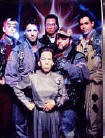
Another new sf show is CBS's Space Rangers, about a motley crew of law officers out on the frontier. We have the standard stock characters here: the disillusioned yet macho hero, his butch female first officer, the gun-happy rookie, the prissy bureaucrat, the prisoner who'd rather kill himself than talk, the ugly weird-talking smuggling bad guys, and the robot which self-destructs when faced with something illogical. And of course, the know-it-all, see-it-all, zen-spouting alien (who actually said in the first episode "Captain, I sense danger!") Combine this characters with the now-overused Aliens look (grimy, gritty, dark lighting, big guns), and the patented "Battlestar Galactica Take-off Tubes™," and you have a show that should be avoided at all costs. Okay, so there a couple of dim sparks: when the engineer hits a piece of faulty equipment in frustration, a computer voice replies, "Please don't strike the equipment;" and the sfx involving an alien that could disassemble itself were very good. (They killed this alien, who had an ultraviolet radiation nervous system by the way, by shooting it.) Pen Densham, responsible for that recent pseudo-epic Robin Hood - Prince of Thieves, created this mess. The only cast member of note is Linda Hunt who plays our heroes' commander. She spends most of her time looking lost and befuddled.
Go out of your way to avoid this.
Originally published by Under the Ozone Hole Number Three - February, 1993
seaQuest DSV

reviewed by Karl Johanson
So I'm watching an episode of seaQuest DSV. (Take your pick of the following. 1: It was by mistake, I was looking for another show. 2: I needed to test my new remote control and one show is as good as another for that. 3: Someone else wanted to watch it and I was stuck in the room with them. 4: Gaby ran off with the remote control so I couldn't change channels or turn it off. 5: I accidentally mistook the episode for one of those Jacques Cousteau specials. 6: I only watched it so I could write this review. 7: It was seaQuest or reruns of The Price Is Right. 8: I only watch it for the scenes of Lieutenant Hitchcock doing her exercises.) In this episode a sub full of scared kids is trapped on the bottom of the sea. On the surface in a life raft is Smart Ass, Dr. Meaningless Polysyllabics, Wesley Crusher, and, Token First Officer.
The Seaview, opps, I mean the Seaquest (is that one word or two?) is looking for the sub full of singing, scared kids and the life boat. To find the life boat they have a floating piece of high tech floating on the surface attached to five kilometers of metal cable. One of the crew men says to the captain, "Hey captain, there's lightning and it might hit the hunk of high tech we've got floating on the surface and wreck it" (although it sounded remarkably like "What's an actor of your calibre doing in a piece of drek like this?") The captain keeps the neat thing on the surface to look for the lost stereotypes crewmen.
Cut to a scene of the scared kids in their sub and the tension building reading on the O2 gages.
Sure enough, just before the hunk of high tech detects the life raft, it gets hit by a bolt of lightning. (The high tech thing, not the raft.)
What happened next convinced me that Gaby must have been chewing on my 68 button TV / Super VHS digitalizing video editor remote control, and that she had hit the "@#$% up the picture in some random way" button with one of her canines. So I grab the telephone and called John and Monica. The conversation went something like this:
Karl: "Hi, it's me."
Monica: "Hi, me."
K: "I think our tv might be busted."
M: "How come?"
K: "Something weird just happened on it. I figured I'd see if it happened on your tv too, which will prove that ours is okay."
M: "Shoot."
K: "Did a lightning bolt just shoot down and hit the high tech floating thing, then, without grounding out into the water, did the lighting bolt spiral down the outside of the 5 kilometer metal cable, where it hit the Seaview, oops Seaquest, and spiralled around the sub as if in some search pattern until it found a way inside where it spiralled randomly about all of the winky-blink panels jumping off on occasion to hit a few assorted crewmen, thus rendering all of the subs neat things inoperative?"
M: "Yeah that's what happened on our tv too. Yours isn't broken."
I said goodbye and went back to watching the episode. A few minutes later the phone rang.
M: "I think there's something wrong with our tv now."
K: "Oh, why's that?"
M: "Did they just say, ‘Hey we can get power from one of the WySKers (an acronym for neat bright glowing robot minisub / remote control sensor things that follow the Seaview Seaquest about looking for lost subs full of scared kids) because they're protected against that sort of thing’?" (italics added for sarcastic effect)
K: "Yeah, they said that on our set too."
Monica and I agreed that it was a good idea for the subs designers to have foreseen a lightning bolt coming down a five kilometer cable and disabling everything on the main sub and for them to have planned ahead and shielded the WySKers from the danger.
The last episode I watched featured a giant squid grabbing on to the Seaview. A giant squid with tentacles that sting people, (believe me, I'm not making this shit up) and bright glowing blue squid poo that gets mistaken for a new gemstone.
Originally published by Under the Ozone Hole Number Seven – March, 1994
Subscribe to:
Posts (Atom)